

Your dog is a wonderful addition to your family, but also a part of our community. It is your job to make sure that your dog is a good canine citizen. Follow these tips to be the best dog owner you can be.
Congratulations on your new pet!
Bringing a new companion home is an exciting time, and we’re here to help make the transition as smooth and successful as possible.
Select the tiles below to explore important information, helpful resources, and practical tips to help you and your new pet get off to the right start. From settling into a new home and understanding your pet’s needs to health, training, and building a strong bond, these resources are designed to support you every step of the way.
Remember, every pet is unique and may need some time to adjust. A little patience, consistency, and plenty of positive reinforcement can go a long way!
Looking for even more pet tips and helpful advice? Click here for additional resources to help your pet thrive.

Taking Care of Your New Dog
Here are some tips and information to help your new dog integrate smoothly into your family.
Contact us if you have any problems.
Your New Dog and the Community
Dogs can get bored, frustrated and stressed which can cause challenging behavioural problems to develop over time. Enriching your dog’s life with appropriate activities and toys can help prevent these challenging behaviours and help you develop a stronger bond with your dog.
Here are some great ways to enrich your dog’s life:
- Daily walks.
- Social interactions with other dogs and people.
- Interactive toys, like dog Frisbees or other throwing toys.
Other great ways to enrich your dog’s environment include:
- Toys to keep him busy, such as:
- Food or treat dispensing toys, like a Kong or Kong Wobbler. You can put canned food or other treats in a Kong and freeze it overnight to have a toy to keep your dog busy the next day.
- Food puzzle toys challenge your dog to get the food out, and force him not to eat too quickly.
- Chew toys should only be used under supervision.
- Sensory stimulation including:
- Sound, such as calming music.
- Odour, such as lavender or spices.
- Textures, such as brushing.
Read more of our pet tips, from choosing the right trainer for your dog, to dealing with challenging behaviours. As an OHS adopter, you receive a $25 discount on the registration fee for group classes. Visit the OHS Buddy & Belle Boutique or your local pet store to choose the right toys for your dog.
Trimming your dog’s nails reduces the risk of accidental scratches and prevents nails from becoming overgrown. You can ask your vet to show you how to trim your dog’s nails, or you can take your dog to a groomer. To trim your dog’s nails, you need appropriately sized nail clippers and treats. Follow these steps:
- Put your dog in a quiet and comfortable spot.
- Gently handle his paw and reward him with treats. You will see that your dog’s nails are always visible and never retract.
- Holding his paw steady, trim each nail halfway between the end of the nail and the quick. The quick is the red part of the nail that is closer to the paw. Cutting nails too short could result in bleeding or injury.
- Reward your dog with a treat after trimming his nails to help make it a positive experience.
You do not need to do all four paws at once. In the beginning, it is best to keep nail trimmings short to let your dog get used to the experience.
Some dogs love bath time while others may not enjoy it. Here is how to make bath time easier for you and your dog:
- Introduce your dog slowly to water, so he comes to enjoy bath time.
- Talk to your veterinarian or dog groomer to get the right shampoo.
- Place non-slip mats in the tub to give him a comfortable surface to stand on.
- Use the showerhead instead of a faucet to direct the water stream carefully.
- Use cotton balls in his ears to absorb water.
- Avoid his eyes as you wash his coat and skin.
- Rinse him with water.
- Use a towel to dry his skin and coat.
If your dog does not like water, use a waterless bath product available from your local pet store. Some dogs require professional grooming to maintain their coats and may need haircuts every six to eight weeks. Ask for recommendations from your veterinarian about finding a groomer for your dog.
To prevent destructive behaviours, dogs can be trained to stay in a crate while you’re unable to supervise them.
Especially as your dog gets used to his new home, crating properly will help keep him safe.
Common Dog Behaviour Issues
If your dog shows any problem behaviours after you adopt them, here are some tips on what to do to help modify their behaviour. Contact us if you need more help. We also have more information on many of these topics on our website.
When a dog is possessive, he may show teeth, growl, snap or even bite when things that are important to him are touched or approached — this could be food, chew treats, resting or sleeping areas or even his favourite people.
Follow these tips to manage and prevent this behaviour:
- Do not touch or disturb your dog when he is eating, chewing on a toy or sleeping.
- When a food bowl is empty, pick it up and put it away.
- If you need to move him while he is resting or sleeping, call him to get his attention. If this does not work, toss a treat away from him. When he follows the treat, praise him.
- Do not give him savoury chews such as rawhides or pig’s ears.
- If he steals something, do not chase or reprimand him. Toss a treat away from him and the stolen item. When he drops the item, praise him, pick up the stolen item and give him an alternative toy or chew. Advise all family members and visitors to do the same.
- Do not leave food or chews around when visitors are present.
We will let you know what behaviour we have seen in the shelter. However, dogs may behave differently at home, and it is important to manage the situation effectively to prevent problem behaviours.
Dogs chew as a way of expressing normal behaviour. As you get to know your dog, you can teach him what is and is not appropriate to chew. Follow these guidelines to help divert his behaviour appropriately:
- Provide safe and interesting toys such as Nylabones and Kong toys filled with cheese spread.
- Keep items you do not want destroyed out of his reach.
- When you are away from home, confine him to a safe place such as a room, crate or exercise pen.
- If you see him start to chew on an inappropriate object, say, “no,” and gently exchange the object for an appropriate object. To an untrained dog, all things are chewable.
- Bitter sprays and ointments are safe deterrents.
- Help your dog burn off excess energy through exercise. Every dog is different, so watch him carefully and talk to your veterinarian. Easy and effective ways to exercise are brisk walks or jogs, playing fetch and arranging playgroups with other dogs.
When your dog chews your favourite pair of shoes, he is not intentionally being destructive, he is simply having fun and exercising his need to chew.
Some dogs are afraid of loud noises. If your new dog shows these signs, keep him inside whenever there will be fireworks, a storm or even an air show. Dogs can be so frightened by noises that they destroy things to get to safety. Mask the noise with a fan or air conditioner. You can also take your dog to a room like a bathroom or basement that is insulated from the noises, or put him in a crate padded with blankets.
While your dog is new to your home, he will be getting used to a lot of new noises. Monitor his reactions to see if he is becoming more used to sounds or needs more help to cope with distressing noises.
Some dogs display signs of separation anxiety shortly after arriving in a new home. Dogs with separation anxiety may bark or howl, be destructive and eliminate when left alone. This behaviour tends to be centred on doors and windows. Dogs often chew doorways and windowsills or pull up carpeting by an entrance to try to escape.
Here are some methods to help your dog to adjust:
- On your dog’s first day home, leave the house for brief periods of time. Ignore him as you leave:
- First, go in and out the door.
- If he does not panic, take the trash out or pick up your mail.
- Leave the house for five-minute intervals, then try 10 minutes.
- If you drive to work, drive your car away and over the first two days, progress up to 30 minutes of being away.
- Allow him to relax between departures. If he panics, slow down. Wait a couple of hours before leaving again, and keep your absence brief.
- Ignore him when you’re leaving, and don’t make a fuss when you return and he will learn to do the same.
- A Kong toy filled with cheese spread can provide a distraction during your departure.
- Crating a dog with separation anxiety, unless done properly, can escalate their anxiety. If crating your dog does not work, you may need to consider other options, such as daycare, family, friends or dog sitters to minimize the amount of time your dog is alone.
- Research supports the use of anti-anxiety medication in conjunction with behaviour modification. Consult your veterinarian or a veterinary behaviourist to see if your dog could benefit from this.
Preparing your dog for periods of time spent alone will make things easier for you and your pet.
If your dog is sensitive about handling, you can help him become more tolerant by slowly working with him. For your and your pet’s safety, go slow, pay attention to his body language and do not push your dog’s limits. Increasing his comfort with handling will make veterinary visits, grooming and other handling requirements easier for you and him.
To start, make a list of all things you must do to your dog for his health that might be uncomfortable, such as brushing, wiping paws, cleaning ears and trimming nails.
Common places dogs don’t like to be touched include feet, hind end, tail and mouth. Your dog’s handling issues may show up when you are brushing him or wiping his paws.
Start with the least uncomfortable activity and gradually begin to associate bits of the activity with his favourite treat.
Follow these guidelines to help increase your dog’s handling tolerance.
For wiping paws:
- Touch a paw with a towel and then give a treat.
- Touch each paw with a towel, give a treat.
- Now, touch each paw three times and give a treat after each touch
- Pick up another paw and give a treat.
- Go through all four paws three times.
For grooming:
- Show your dog the brush and give a treat.
- Touch him with the brush and give a treat.
- Run the brush down his back upside down (bristles up) and give a treat.
- Turn the brush over and give a treat.
- Finally, run the brush down his back with the bristles down.
If at any point your dog seems upset, immediately stop the activity. Consider hiring a professional to safely help you work on your dog’s sensitivity.
Dogs commonly learn to escape to seek things beyond their home or yard, such as people, other dogs and food. New dogs who don’t have any sense of home are at greatest risk of escaping. Follow these guidelines to help keep your dog safe:
- Keep your dog contained within a physical fence while he’s on your property.
- Supervise him when he’s outside.
- Keep him leashed at all times when he’s off of your property.
- Teach him to sit and stay before you open the door and to wait until you exit the door. Teach all family members to do the same.
- Lock your doors and windows until you’re confident that he’s no longer attempting to open them.
- Keep him busy in the yard with toys like Kongs and scavenging games.
- Enrol your dog in a dog obedience class.
Contact us if your dog escapes. We can give you tips to help get him home.
Your new dog may seem afraid of some people — he may put his tail down, hide, cower or tremble. Some dogs will even bark or growl at someone they are afraid of. If that person reaches out, your dog may snap or bite. You can help your dog by controlling situations that he finds fearful:
- Have all new people sit, and have them toss or hand a treat to your dog.
- Ask all new people not to look directly into his eyes.
- Ask all new people not to pet him unless he approaches them and solicits attention.
- If he likes to play, give a favourite toy to the new person. Have the person throw the toy to engage him.
- Forcing a fearful dog to accept people before being ready can result in increasing the dog’s fear and could end up with the dog snapping at or biting the person.
- Do not take him places with lots of people and stimulation.
Remember to take it slow and to pay close attention to how your dog feels in a new situation with new people.
High-arousal, Jumpy or Mouthy Behaviour
Dogs that jump up are often seeking attention — to play or just say hello. Jumping may be accompanied by the dog’s mouth on the person’s arms and legs. You can help curb this behaviour from the beginning, by following these tips:
- If your dog is jumpy or mouthy, turn your back, stand still, cross your arms and close your eyes. If he does not stop, leave the room, or restrict his access to you by putting him in a crate or on a tether. As soon as your dog does something you want, reward him with your attention or a treat.
- When he becomes playful or mouthy when you are attaching his leash, distract him with a chew toy to redirect his behaviour.
- Expend his energy by playing games such as fetch.
- If he is good with other dogs, give him lots of time at the dog park or have play dates with other friendly dogs.
- Do not knee, grasp his feet and squeeze or grasp his muzzle or scruff to stop jumpy or mouthy behaviour. Many dogs misinterpret these behaviours as play and think that they are fun, which can encourage more bad behaviour. Other dogs may find these actions frightening.
While your dog likely does not mean any harm, it is not a behaviour that most people enjoy, and teaching your dog proper manners will help him make more friends.
Dog-reactive dogs may lunge, pull, whine, bark or growl at other dogs while leashed. Some may even snap or bite other dogs that get too close. Off-leash, however, many of these dogs are friendly with other dogs. Manage this behaviour effectively from the start to prevent it from becoming worse, and follow these tips to help decrease your dog’s reactivity:
- Take a handful of treats with you on every walk.
- Use a properly attached harness or Gentle Leader.
- When you see a dog, use treats to distract your dog and keep walking. Do this even if he does not react. When he is not being reactive, ask him to sit, then praise and treat.
- If he reacts to every dog, you may be getting closer to other dogs than he can tolerate. Increase your distance.
- Until you get to know his off-leash behaviour, don’t go to dog parks. If you have a safe fenced-in yard, try to have a play date with another friendly dog.
If you’re having troubles, consider signing up for an training class with a trainer who can handle reactive dogs. Make sure you let the trainer know about your dog’s reactivity.

Taking Care of Your New Cat
Here are some tips and information to help your new cat integrate smoothly into your family.
Contact us if you run into any issues.
A cat is a wonderful addition to your family, but just like any of your family members, she needs your care and protection. Follow tips on our website to be the best pet owner you can be.
Meeting Your New Cat's Nutrition Needs
With your adoption, unless your cat was on a special diet, you received a sample bag of food from Hill’s. Each bag has a feeding guide with portion sizes based on age and weight. While at the OHS, your cat was likely on one of the following diets:
- Hill’s Science Diet
- Hill’s Healthy Advantage
- Hill’s Prescription Diet
If your cat was on a prescription diet at the OHS, we recommend keeping her on that diet. As always, consult your veterinarian for the optimal diet for your cat.
Click here for more information about Hill’s cat food.
Trimming your cat’s nails every few weeks will reduce the risk of accidental scratches and prevent them from becoming overgrown, which can be painful for her.
To trim your cat’s nails, you need the right tool and treats. There are many tools available, from specialized nail scissors, to plier-like clippers, to clippers with a sliding guillotine blade. Choose the tool that works best for you. To clip nails:
- Bring your cat to a quiet and comfortable location.
- Hold your cat firmly, but gently. You can restrain her in the crook of one arm, while holding her paw in another, or use a towel to restrain her. Alternatively, have a helper hold your cat while you clip her nails. If your cat is upset by this, consider hiring a professional.
- Take her paw in your hand, curl your fingers into a fist and use your thumb to press gently down on the joint above the knuckle. When the claw extends, clip off the tip of the nail. Do not cut too close to the pink part as this may cause bleeding.
- Few cats will sit long enough to have all nails cut in one sitting. It may take several sittings to get all her nails clipped.
- Reward your cat with a treat after trimming her nails to help make it a positive experience.
If you can’t trim your cat’s nails yourself, your veterinarian or a local cat groomer can do it for you.
Cats, especially ones with medium to long hair, get uncomfortable hair mats if they are not brushed regularly. Mats can also create skin problems and cause significant distress to your cat. Use a wire or slick plastic brush to brush your cat regularly to prevent mats. If your cat does become matted and you cannot brush her yourself, be sure to contact a groomer, as the mats will only get worse over time.
Some cats benefit from an occasional bath due to coat conditions. Talk to your veterinarian to see if your cat may need bathing. Since most cats do not like water, you may want to try a dry shampoo specially formulated for cats and available from pet stores. Don’t use human shampoos, which may harm your pet’s skin.
Getting Your Cat Used to a Cat Carrier
You will need a carrier to transport your cat. Keep the carrier visible to let her get used to it. Make it inviting by placing a blanket inside. You can feed her in the carrier — leave the door open and place a bowl of canned food at the very back. If she does not go in on her own, do not force her. Leave the food there for 10 to 15 minutes, then remove it so it does not spoil, and try again later. Feed her all meals in the carrier. Once she is comfortable going inside, close the door for about two minutes, then release her and give her a treat. Try this a few times a week.
Keeping Your Indoor Cat Happy and Healthy
Indoor cats live longer, healthier lives. We recommend you keep your new cat indoors. Some cats adopted from the OHS have formerly been outdoor cats, so we are happy to provide tips to help you transition your cat to an indoor lifestyle. You may also be able to harness train your cat so she can enjoy some time outside.
Your cat does not have to go outside to be happy. There is a lot you can do to keep her stimulated and engaged indoors, from playing with her, training with her and providing her with a great environment that allows her to exhibit all of her normal cat behaviours.
Cats can also be trained to sit, stay, fetch and other tricks. Training your cat is a great way to bond with her and keep her in shape.
Cats that are bored are more likely to become stressed and to develop bad habits. You can enrich your cat’s life with toys or by creating cat-friendly zones in your house Here are some tips and toys to try:
- Self-play toys: Your cat can play independently with toys that encourage chasing and pouncing, including some battery-operated ones.
- Food puzzles: Food puzzles, puzzle feeders and treat dispensers satisfy a cat’s natural instinct to search for food. Some are stationary, while others are designed to move around.
- Interactive toys: Interactive toys, like cat wands, help strengthen the bond between you and your cat by letting you share fun and positive experiences.
- Vertical spaces for cat enrichment: Upright structures and elevated perches serve your cat’s climbing and scratching needs. Place perches, cat furniture like cat trees and resting areas by windows so she can see outside.
- Cat comfort zones: Provide areas where your cat can retreat and relax. These may be an open crate, high shelf, cat tree or a space under a bed or in a quiet room where she cannot be disturbed by other pets or kids.
Increase her confinement time to equal the time it would take you to drive to the vet. That way, when you do have to go, it will not be as stressful for her.
Common Cat Behaviour Issues
If your cat shows any problem behaviours after you adopt her, here are some tips on what to do to help modify her behaviour. Contact us if you need more help. We also have more information on many of these topics on our website.
Going to a new, strange environment can be stressful for any cat. But ones that are a bit more shy or fearful to begin with can have a harder time. They will usually slowly become more confident as they get used to their new home and daily routine. Here are some tips to help your cat adjust:
- Follow our isolation guidelines to help your cat slowly transition.
- Let them explore the house gradually. Too much territory at once can be overwhelming. If they regresse, confine them back in their safe room for a few days and start over.
- Talk softly and move slowly around your new cat. Avoid staring or approaching them directly, which can feel threatening. Try crouching to their level when you interact with them, instead of towering over them.
- Never pull them from a hiding place or force them to be held. This will increase their fearfulness and may lead to them biting or scratching.
- Some cats are play-motivated. Try a regular play session to help them become more comfortable.
- Try not to startle them. If you have to do anything noisy in the house isolate them in their safe room.
Remember to take it slow and move at a pace your cat seems comfortable with.
Play aggression can occur in a cat of any age. Play aggression in cats involves biting and clawing as well as stalking and attacking people and generally treating people as a cat would treat prey or another cat. Help your new cat learn appropriate play using both interactive and self-play toys. If at any time they attack, immediately stop so they learn that play stops when they get too rough. Ignore them for a while and only resume play once they have calmed. If you are consistent, they will learn that they will only get to play with you when they're well-behaved.
Cats can get overstimulated when they’re petted or handled in a way that’s not comfortable or that goes on for too long. An overstimulated cat might bite or scratch. Watch your cat for cues as you get to know her, so that you can prevent her from becoming overstimulated.
Keep petting sessions short and to the areas where your cat enjoys your touch. If you know she may get overstimulated after two minutes, then only pet her for one minute.
Most cats like to rub their faces or bodies on an offered hand, but do not appreciate long strokes over their bodies.
Watch for signs of overstimulation and impending aggression. Cats almost always give clear warning signals before biting or scratching, including:
- Tail swishing or flicking.
- Skin twitching over the back.
- Flattening of the ears.
- Freezing, tenseness or staring.
- Quick head turn to watch your hand as you pet.
- Dilated pupils.
- Low growl.
- Walking away and lying down.
If you see any of these signals, stop petting her and don’t touch her until she settles down, which could take minutes or hours.
Remember, do not punish your cat if she rejects your affection. Yelling, pushing or hitting your cat will make her fearful of you and may cause her to become more aggressive.
Scratching is a normal cat behaviour, but it can also be a destructive one. Read how to train your cat where to scratch appropriately, so that they can express their normal behaviour without damaging your home.
It is normal for cats to use litter boxes, but your new cat has been through a lot of change and may need help to make sure they know where to eliminate. There are many reasons that a cat may house soil, and most are easily fixed. If they do house soil, make sure you take steps right away to address the problem.
Is your new cat very vocal? Cats vocalize to express discomfort or pain, agitation and in some cases, to protect their territory. A new cat may be meowing because they're stressed and getting used to a new environment. Other stressors, such as moving or introducing another pet, may lead to more vocalization. If they have lost a companion or is lonely they may be more vocal.
Unneutered males may yowl in conjunction with sexual behaviour, and females meow when in heat. Since your new cat is sterilized, that is likely not the problem.
Cats also learn that if they meow, they usually get attention. Some owners love to talk with their cats, so if you have adopted an adult cat, this behaviour may have been encouraged by a previous owner. Give your cat time to settle in to see if the meowing decreases. If they continue to meow excessively, ignore them, do not talk to them or provide them food or play when they're being vocal.
Once you have gotten to know your new cat, pay attention to any changes in their vocalization. If there is a change you do not understand, consult your veterinarian for advice.

Taking Care of Your New Small Animal
Small animals can make wonderful pets. Here are some tips and information to help your new small animal integrate smoothly into your family.
- Learn how to properly care for your small animal. Find out what food, daily activities, and environment he needs. Proper care and nutrition will help keep them healthy. Follow these tips on our website to be the best pet owner you can be.
- Schedule a vet visit right away for your new pet with a vet who has experience with small animals and talk to your vet about how to keep them healthy.
- Examine your pet daily and watch for any changes in their activity level, appetite or health. If they seem sluggish or depressed, has a dull hair coat, loose stool, runny eyes or nose or abnormal breathing contact your vet.
- Schedule regular veterinary checkups for your pet. Talk to your vet about how often that should be.
- Handle your pet carefully to avoid bites and scratches. Be especially careful while you are getting to know them. You will get to know their signals and they will become more comfortable with you.
- Never disturb them while they're sleeping, as they're is more likely to bite if startled.
- Avoid poking your fingers between cage bars or in front of your pet to avoid them thinking you are offering them food.
- Avoid kissing them or holding them near your face.
- Keep them out of the kitchen or other areas where food is prepared, and do not eat while you are handling them.
- Avoid skin contact with their droppings and urine, and wash your hands with soap and running water after contact with your pet, their bedding, urine or droppings.
- Shortly after adopting, tell your health care provider about your new pet.
- If your new pet bites you and the bite breaks the skin, wash the wound immediately with warm, soapy water and consult your physician. Even healthy pets can carry germs.

Isolating Your New Pet
We believe your new pet is healthy, but animals can hide illness before they start showing it. To keep other pets healthy and to help your new pet settle in, isolate your new pet from other animals for the first two weeks after adoption.
Isolating your new pet will:
- Help them get used to their new environment, including new sounds and smells.
- Help prevent the spread of any illness they may be hiding.
- Help reduce the stress of moving into their new home.
Isolate your new cat for 14 days in a separate room, away from other pets. Find somewhere that is calm and quiet to help it adjust better and faster. Make sure it has:
- A soft bed.
- Food and water.
- A litter box.
- Appropriate toys.
- Places to hide, scratch, perch and see out of a window if possible.
Leave their carrier and Hide & Perch box in the room. Leave their carrier open with a comfy blanket, toys, treats and food in it to encourage it to go inside. This will help it get used to being in its carrier and will make future trips to the vet easier. Separate the litter box, feeding area and sleeping area at least three feet apart.
Isolate your new dog by keeping it away from other pets as much as possible and not allowing it to make contact with other dogs outside.
Isolating your new dog can be difficult, but it will help keep everyone healthy, let it settle faster and allow you to get to know their behaviour better before it makes new friends.
For at least the first 14 days:
- Keep your new dog away from other dogs while you are walking it.
- Do not take it to dog parks.
- If you have another dog, limit their interaction as much as possible.
- Learn more about introducing your new dog to your resident dog.
When you leave your house, keep your new dog away from other pets in an enclosed space equipped with comfortable bedding, toys, food and water.
Keeping Your New Small Animal Isolated
Isolate your new small animal (hamster, guinea pig, bird or other small animal) by housing them separately from other pets.

Helping Your New Pet Adjust to Your Home
Your new pet needs time to get used to their new surroundings. Whether you have adopted an energetic puppy or kitten, or an older, mellow cat or dog, follow the tips below to help them feel right at home.
Don’t overwhelm your new pet with attention, at first they may not want to cuddle or play.
Isolate your new cat in a separate room set up with litter, bedding, toys, food and water for 14 days. Let them explore the space by themself.
Isolate your new dog from other pets for 14 days and give them their own bed or safe spot where they can rest. Give them time to get comfortable and bond with you before you invite guests to meet them.
After your new pet’s isolation period, let them explore your home and give them time to become familiar with your family.
Do not overstimulate your new pet. If they come to you for attention, be only as affectionate as they seem comfortable with.
While your new pet was at the OHS, unless they were on a special diet, they likely ate Hill’s Science Diet. As they transition to your home, continue that diet to reduce the risk of an upset stomach.
The stress of adjusting to a new home can lead to a loss of appetite, and even diarrhea. Monitor your new pet’s eating habits, and consult your veterinarian if you have any concerns.
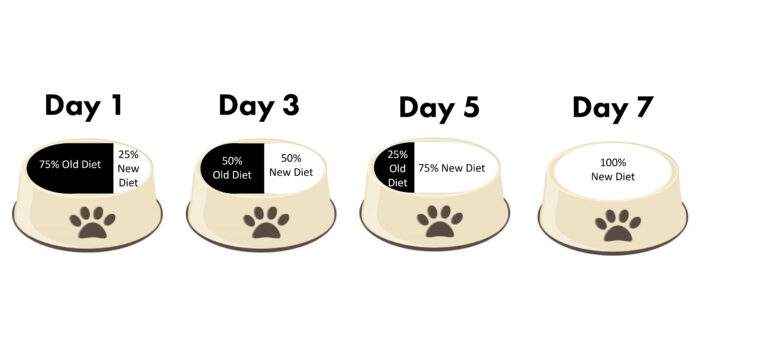
If you want to transition your pet to a new food, do so gradually. It takes about a week to safely transition food. Unless you have received other instructions from the shelter or your vet, use the graphic below to help you transition your new pet’s diet.
Be consistent with:
- Daily feeding times.
- Play times.
- Bedtime.
- Walks and bathroom breaks for your new dog.

Creating a Safe Home for Your New Pet
Pets can be curious in a new environment and can get into a lot of mischief. Make your home as safe as possible to prepare for your new pet’s arrival.
Kitchen, Bathroom and Laundry Room
- Use childproof latches to prevent them from opening cupboards.
- Place medications, cleaners, chemicals and laundry supplies on high shelves or in secured cupboards.
- Keep trash cans covered or inside a latched cabinet.
- Monitor spaces your new pet could jump into and get stuck.
- Keep washer and dryer doors shut and check before use.
- Keep all food out of reach as some foods are toxic.
Living Room, Family Room and Bedroom
- Monitor electrical cords and wires — they are tempting chew toys for pets.
- Store away small objects that could be a choking hazard for your pets.
- Store away fragile items while your pet gets used to your house.
- Move common house plants that may be poisonous out of reach.
- Move chemicals to high shelves.
- Clean surfaces that have come into contact with antifreeze.
- Keep all sharp objects and tools out of reach.
Consult with your veterinarian immediately if your pet has come into contact with any common household poison or other poisonous substance.

Introducing Your New Pet
You may want to show off your new pet right away, but too much excitement can be stressful for them. Let your new pet bond with you first. When they are ready to meet new friends, follow these steps for a smooth introduction.
Introducing Your New Pet to New People
- Confine your new pet to a separate room until everyone is sitting down.
- Let them make the first move. They may come to you for attention.
- Ask visitors to offer or toss your pet treats to help build trust between your pet and the visitor. When giving treats, visitors should either stand sideways or crouch down and not make direct eye contact.
- If your pet displays signs of fear or shyness, give them space and let them go to a place they feel safe. If they hide behind you or seek your comfort, they are not ready to meet new people.
Introducing Your New Dog to Your Resident Dog
At the OHS, you may have successfully introduced your resident dog to your new dog. This introduction took place on neutral territory, their behaviour with each other may be different at home. After the 14-day isolation period, follow these tips to help your dogs successfully adjust to one another:
- Put away any toys or items that you think your resident dog may be protective of.
- Remove clutter and create a lot of space for your dogs to meet.
- With your resident dog off-leash, bring your new dog in on their leash, and walk them through your home, letting them explore each room. If your resident dog seems comfortable, take your new dog off-leash.
- Walk the dogs together as if it were routine. If they get along on neutral ground, allow them time together off-leash in a fenced area.
Monitor your dogs closely for the first few weeks, and don’t leave them alone together. Follow your resident dog’s routine with your new dog, to get them onto the same routine.
Introducing Your New Cat to Your Resident Cat
Isolate your new cat from your resident cat for 14 days to allow for a smooth transition and prevent the transmission of any contagious illness your new cat may be hiding. During that period, you can begin feeding both cats at opposite sides of the door separating them.
After 14 days, begin introducing your cats to each another:
- Slightly open the door to your new cat’s isolation room. Allow the cats to see only see each other through the door’s opening.
- Monitor their body language and noises. Low, swishing tails, growling or pinned ears means they’re not ready to meet.
- If they are sniffing with their tails standing up straight and seem comfortable, open the door further to let them see more of each other.
- If they both still seem happy, let them meet.
- For at least the first week, monitor them carefully and do not leave them alone together until you are confident that they are getting along.
- If your cats fight, throw a towel over each cat and return your new cat to their isolation room. Begin the 14-day isolation period again.
Cats can be territorial and many do not like change. It can take a few weeks for them to be comfortable with one another. Do not be discouraged if your cats do not immediately get along.
Introducing Cats and Dogs to One Another
Dogs and cats can live together and even be friends, but it may take training and patience.
When they are not getting along, it is important to know when to stop trying. Keeping an animal in a situation where they are endangered by another animal is unsafe. The animal will live in fear, stress and danger.
Before introducing a dog to a cat, consider the following:
- If your dog is aggressive or has a predatory nature, they could seriously injure a cat.
- Puppies may adjust better to a resident cat than older dogs. Puppies can grow up with the cat as a part of their family.
- Cats may not be comfortable with an overly playful dog. Small kittens are also not safe around an overly playful dog.
- Cats that are declawed, older or have mobility issues are less equipped to defend themselves.
- Before meeting your cat, make sure your dog is responsive to instruction, so that you can guide their behaviour with your cat.
- If your dog is too rough with your cat, immediately remove your dog from the situation and restrict their access to your cat.
The First Introduction
- Exercise your dog and feed them before meeting your cat. Make sure they are not over-excited.
- Place your dog on a leash or in a crate. Place your cat in its carrier and let it see your dog from the safety of its carrier. Provide treats to both pets and speak soothingly.
After the First Introduction
- Keep your dog on a leash while letting the cat roam freely.
- If your leashed dog bolts toward your cat, remove it from the situation until it is at a distance where it can remain calm.
- If your dog is over-excited, calm them.
- Repeat short visits several times and gradually give your dog more leash as appropriate.
Once your dog and cat consistently get along during leashed visits, begin taking your dog off-leash. If there are no incidents, gradually make off-leash sessions longer. Eventually, you should be able to leave both pets without supervision.
If you see signs that your dog or cat is uncomfortable, return to leashed introductions. If you see any signs of aggression or predatory behaviour in your dog, end the introduction immediately and call or email us.

Housetraining Your New Pet
One of the most important steps towards building a great relationship with your new pet is taking the time to make sure they are housetrained. Housetraining will save you lots of frustration and will allow your pet to express normal, natural behaviours.
Most cats do not need to be litter trained as they use a soil-type surface to eliminate by nature. Give them an appropriately sized litter box, and select a type of litter that works for you. Choose a calm, quiet location that your cat can easily access and where it will not be interrupted.
Smaller cats and kittens can use a litter box with lower sides so they can get in and out easily. As your cat grows, increase the size of its litter box. If a cat’s litter box is too small, it may soil outside of it.
Remove fecal matter and urine daily to keep the litter box clean. Change the litter about once a week. Follow the instructions on the litter package. Keeping the litter box clean will help prevent house soiling issues.
Have one extra litter box for the number of cats in your household. If you have three cats, have four litter boxes throughout your house.
Housetraining your new dog or puppy requires patience, commitment and consistency. Your dog may house soil during the first few weeks. Follow these steps to help your dog:
- Having a routine helps to teach your dog when it is time to eat, play and eliminate.
- Take your new dog outside at least every two hours, and immediately after it wakes up or after eating or drinking.
- Pick a spot outside and always take it to that spot.
- Reward it immediately with praise or treats when it eliminates outdoors.
Watch for signs that your dog needs to go out, such as barking, scratching at the door, squatting, restlessness, pacing, sniffing around or circling. When you see any these signs, take it out to its bathroom spot. Mistakes will happen along the way and are a normal part of house training. When a mistake does happen, it is important how you handle it.
- Immediately take the dog to its bathroom spot outside. Praise them and give them treats when they finish eliminating outside.
- If an accident happens while you are not around:
- Do not yell or raise your voice. Becoming upset or angry will likely make your dog afraid of you and they will not understand why you are upset.
- Take your dog to another room or outside and clean the soiled area with a product that will eliminate the odour. This will help prevent them from eliminating in the same spot.
- Do not punish them for eliminating in the house. Rubbing their nose in it does not work and can cause greater behavioural problems.
With a bit of time and effort, rabbits can be litter trained. Here’s how:
- Use an uncarpeted room for litter training to easily clean up any accidents.
- Make sure the room is safe for your rabbit.
- Monitor your rabbit and the spots it eliminates in or sniffs frequently.
- Place a litter pan filled with hay and lined with rabbit-safe litter in those spots.
- If your rabbit eliminates somewhere else, pick up the droppings and put them in a litter pan, and put the litter pan in that spot.
- Gradually reduce the number of pans.
For the best results:
- Keep the litter pan where your rabbit eliminates most often.
- Keep plenty of hay beside the litter pan, so your rabbit can eat while sitting in the litter pan.
- After cleaning, place a few of the rabbit’s droppings in the litter pan.

Basic Veterinary and Health Care Needs
Regular visits to a veterinarian are important to keep your pet happy and healthy. Below, find out more about choosing the right vet, monitoring your pet’s health and when to seek veterinary care.
Establishing a relationship with a veterinarian is the most important step you can take as a pet owner. Be sure to take your new pet to your veterinarian within the first 14 days of adoption.
While the OHS cannot recommend any veterinarian, click here to find a list of local clinics. Here are a few tips to choose the right clinic for you:
- Ask your friends. They can offer feedback about the veterinary clinic they use.
- Consider hours of operation. If you work week days, it may be more convenient to select a clinic that has early morning, evening or weekend hours.
- Location. If you can walk or take a quick drive to your veterinarian, it may reduce your pet’s stress when traveling to their clinic. City transit also accepts animals.
- Do you need specialty services? Not all vets have expertise with rabbits, and fearful cats may do better with a cats-only vet. Some animals are very sensitive about handling, and some vets specialize in fear-free handling. Some vets will even make house calls.
How to Determine if Your Pet Needs Veterinary Care
A veterinarian should see your new pet regularly, and your vet will let you know how often that should be. If your pet is showing any unusual behaviour — if they are less energetic, vocalizing differently or hiding, it may be a sign there is a problem. Even if you cannot see anything, call your vet. If you notice any different physical symptoms in your pet, you should also call your vet to ask whether your pet should be seen.
Since animals often hide illness, it is important to regularly look at your pet to see if anything is different. The best way to evaluate their general health is to carefully look at them from head to tail, and physically feel them, to ensure that you are not overlooking something subtle. You may feel a strange bump, or notice hair loss. While it could mean nothing, taking action sooner could prevent a small problem from becoming a big issue.
When in doubt, call your vet.
How to Make a Pet Insurance Claim
Having a sick or injured pet can be stressful, but making a pet insurance claim doesn’t have to be. Visit www.petsecure.com/en-ca/claims and review how submitting a claim to our partners at Petsecure can be done in three easy steps. You can also call them at 1-800-268-1169 and they would be happy to walk you through the process and answer your questions along the way.
The OHS offers Pet First Aid courses that will help prepare you for an emergency. From preventative care, to being able to bandage your pet, or knowing what to do if they ingest a toxin, first aid is an important part of taking care of your pet. As an adopter, you receive 25 per cent off of the registration price. If you are interested in signing up click here and use the code ADOPTERPFA to receive your discount.
Most pets will have periodontal disease by the age of three. While the OHS does not knowingly adopt out animals with serious dental issues, your pet will need professional dental care to maintain their oral health. Dental disease can cause your pet a lot of pain. Here are some facts:
- Dental disease can cause bad breath, painful chewing and tooth loss.
- Bacteria under the gums can travel to the heart, kidneys and liver.
- A professional dental cleaning removes plaque and tartar from pet’s teeth.
- Thorough dental cleanings are done under general anesthesia.
- Regular at-home dental care can help improve the health of your pet’s mouth and lengthen intervals between professional dental cleanings.
Dental cleanings may include:
- Removal of plaque and tartar that is visible and under the gums.
- Probing dental sockets to assess disease.
- Polishing to smooth enamel scratches that may attract bacteria.
- Dental X-rays to evaluate problems below the gums.
- Application of fluoride or a dental sealer.
- Removal or repair of fractured or infected teeth.
- Dental charting so progression of dental disease can be monitored over time.
- Inspection of the lips, tongue and entire mouth for growths, wounds or other problems.
Signs that your pet may require a dental cleaning include:
- Bad breath.
- Drooling.
- Pawing at the mouth.
- Difficulty chewing.
- Loose or missing teeth.
You can practice the following dental hygiene at home, which may limit the amount of dental intervention your pet needs from a vet in the future:
- Brush your pet’s teeth daily with a child’s toothbrush or a finger brush and pet-safe toothpaste.
- Feed your pet a veterinary prescription dental diet.
- Provide dental chews.
- Avoid human toothpastes, which contain ingredients that are harmful to your pet.
To keep your pet healthy, have their dental health checked regularly by your veterinarian.
Your adoption package includes your pet’s medical history at the OHS, including which vaccinations they received and a record of when they need their next vaccines. Generally, dogs receive the DA2PP, rabies and Bordetella vaccines, and cats receive the FVRCP and rabies vaccine while they are at the OHS.
Regular vaccinations are very important for your pet’s health. Their benefits include:
- Protecting your pet and others from infectious diseases.
- Stimulating your pet’s defence system.
- Helping your pet to better resist the impact of disease later in life.
If you have questions about your pet’s medical care while they were at the OHS, let us know. If you have questions about vaccines, consult your veterinarian.